Research
Use the links to the side to access the page easier
1 / Primary: Questionnaire - Lockdown
2 / Primary: Questionnaire - Website Design
3 / Primary: Vox Pop
4 / Secondary: All
Primary Research: Questionnaire - Lockdown


For this questionnaire, I sent it out to my friends that I had made online during the time of the COVID lockdown in 2020. I did this as I knew that there would be more people that would respond compared those in school. It also meant that I got a range of answers from people around the country/world. They were also a part of my target audience so I knew that the answers that I got would be beneficial for my final project.
The reasoning that I decided to do a questionnaire for my primary research was because it has many good reasons to conduct. It is free to do, simple to create one and only takes a few minutes out of people's day to fill out. There are a few disadvantages such as not being able to see the responder's reactions and also a limited amount honestly as there is no way to tell if they are being honest. A big disadvantage for doing a questionnaire on this topic is the fact that the responders may forget what they had experienced during this time.
By using google forms to create this, it helps me to see the information in an easier way as they come back with bar charts, pie charts and contains the percentages. It also allows me to see what the majority has voted for or has said. Google Forms also has an option for anonymity which I enabled so that people would be more likely to answer as it means that I will not know who puts the answers down.
Overall, I made sure to ask questions that would benefit my project and allow me to make good decisions on what to create or do next. It gave me an insight on how people experienced the lockdown, despite being from different parts of the world to me and their views on lockdown as a whole. I asked what hobbies they had found / dropped as it will allow me to create more ideas for what to add to my final piece.
Questions 1 & 2:

For these questions, they are not directly relevant towards my topic or outcome. However they do inform me that I am making sure to including a range of different ages and gender.
Most of the respondents were 17 (40%) and female (50%), which I had expected as majority of my friends are the same age as I am and they are mostly female.
I did not include locations, but from the people I had sent it to, I knew that they could be located in the following countries; America, England, Egypt, Malaysia, Netherlands, Scotland, Sweden and Portugal.
Questions 3 & 4:
These questions were close ended so that I could collect quantitative data, to see the overall answer on how people felt during COVID.
The majority had a positive experience during the lockdown but also had a negative experience at the same time.
This means that despite there being good times, there was still some low points.
From this data, it means that I should focus on both sides to isolation and at an equal amount as most people had both good and bad experiences.

Question 5:


This question was specifically aimed towards understanding what areas of the COVID lockdown people had enjoyed and what they liked the most.
Majority of the people had said that they enjoyed finding and meeting online friends (which was expected as I had sent this to my online friends). However, outside of this, people had enjoyed gaming, spending more time with friends and doing simple things such as Greggs sausage rolls.
I will include these things and also the findings I get from my college friends to decide what to make as part of my good side for the final project. I may also include a few things that I enjoyed during the lockdown such as going on walks with my mum and playing football with my brother.
Question 6:

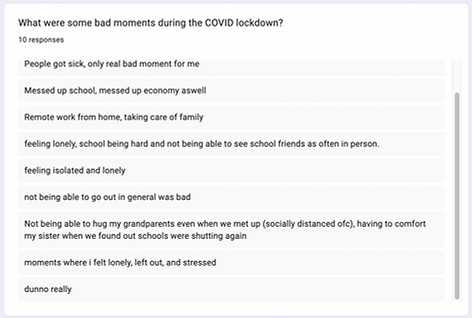
This question was specifically aimed towards understanding what areas of the COVID lockdown people had not enjoyed and what was the worst areas of the time.
Majority had said doing school work from home, not seeing friends, and feeling lonely. People had said that not going out was also a big factor. A few people had mentioned that not seeing family members was an issue and even not being able to hug them had impacted them.
I will hope to include some of these things in my final outcome towards the negative side, and if i don't completely include then I will put it as a hidden message.
Question 7:

This question was asking about if people had felt lonely or alone during the time which 60% had said that they did. This was a bit lower than I thought it was going to be but I will contain both aspects as it was a close vote between feeling alone and not feeling alone.
By adding scenarios where people are by themselves and with others is how I will achieve this
Question 8:
This question is very short as its elaborated on in the next section.
The results however were expected as I knew that majority had known it was not a good thing for everyone.
This means that I do not need to go too much into detail about the negatives as its a given.

Question 9:


As a continuation for Q8, I had people elaborate on why they had put the answer they had put down.
Majority had the same base idea of that people were not able to see others and that social interaction was lowered. Some mentioned that their school grades could have been better and that moving to a more online world allowed people to come together.
This shows me that people are aware and know what had happened to others during COVID and that there will not need to be a whole story to explain why I had a certain person feel this way.
Question 10:


With this question I had asked what hobbies people had picked up during COVID as this was a large amount of time spent at home and it allowed for people to do a lot of discovery about themselves and in general.
Many people had picked up gaming, reading and watching video content. A few people had started things such as crocheting and volleyball.
With this information, I will hopefully use it in my final outcome as I will be using them as scenarios that people are doing, mainly towards the good side.
Question 11:


This question was in relation to the question above, so that I could understand if COVID had impacted an activities someone had done before the whole pandemic had started.
Majority had said that they didn't end up losing any hobbies but the ones that was mentioned were mainly exercising activities. One mentioned that they lost the things they had done with their friends, and another lost their hobby of reading books.
With this information I will maybe include a few hidden messages behind the actual scene such as a person with exercise equipment and perhaps some books in the background so that it shows they once had that hobby but since lost it.
Question 12:

This question is explained more in the next question, but the majority of the answers in this was expected.
People understand that COVID has changed the world in some sort of way and that if there was another lockdown, it would not be the same as it was back in 2020.
Question 13:


This questions was continuing on about what I said earlier, but obviously people are giving reasons as to why they had put down the answer they had put.
Majority understood that we would be more prepared if it was to happen again but it would also still have the same effect mentally on the younger generations.
This data tells me that the people who are most likely going to be viewing this will have an idea as to how the world has changed with the pandemic and that if it were to ever happen again, there would be a sense of familiarity but also the same issues occurring again in relation to mental health.
Question 14:

This wasn't really a question as I had just asked if anyone had any more input towards what was brought up in the questionnaire.
There wasn't much given back, but a person had said that lockdown was the best years of their life. Whilst another had said quite the opposite and that it wasn't such a positive experience.
Primary Research: Questionnaire - Website Design


For this questionnaire, I had sent it to everyone who I sent the first form too, however not all answered it, which was expected. As they are part of my target audience, I know that it means that the answers I get will help me reach my target audience whilst also aiming the design towards them. The information that I get from this will be used to create my website in a way that means the majority enjoys it.

Question 1 & 2:

For Question 1, I asked what people see as the most important thing so I know what I should put more time into when creating my webpage. They had mostly said layout and color schemes, whereas none had said font. This lets me know that asking questions for my website can help to target my work towards my audience.
My second question was to ask about interactivity with the website as some prefer to see images alone or images altogether. Everyone had said that they prefer to see them all together and selecting to see them larger which was good as I had planned to do this.
Question 3 & 4:
In question 3, I asked what social media platforms people would expect to see photography on. Everyone had said Instagram, some said facebook and also twitter. This will help me know what platform is best to post the photos on as this is what my target audience has said so I will know that they are most likely to see it.
Question 4 was a continuation of question 3 to ask if it would be beneficial to upload the final photos to social media in which everyone had said yes. So based on this answer I will be uploading this to my instagram and possibly my twitter as well. I possibly wont add it to facebook as the app is generally for the older generation and they do not fit my targeted audience.

Question 5:

This question wasn't asking anything specific but I had asked if anyone had any other ideas that I could use to better my website. A person had said to separate my photos into galleries in terms of the style. I decided to do this but change it to the different emotions as I knew that it would make more sense.
One also said to add title cards on which I was already planning to do.
Question 6:
For question 6, I asked what website layout people preferred. It was an even split with the images below so I have to make my own decision. However I might go with the minimal design where the list is on the side so that I can include the gallery idea.

Minimal


Header + Images
Question 7:

This question I had asked what font people prefer and 50% of people had said ghost (shown below) so I will use that for my final website.

Question 8:
Here I had asked what color scheme people preferred so that I can use it for my photography webpage. It was close between 1 and 4 but the one below (1) got the most votes.


Vox Pop
Secondary Research
Young Minds Survey
The company (Young Minds), which focuses on young people’s mental health, had conducted a survey multiple times during 2020 about the impacts of Covid-19 on young people with a history of mental health needs.
The first survey was completed at the start of lockdown where only 16% of people said that the closing of schools made their mental health better or made no difference. Leaving 83% of those to say it had decreased. At the time 74% of those who had access to mental health support still had it despite the rise of risks that COVID brought. That does leave just shy over a quarter of those who had access before the lockdown that no longer have access to it.
Many students during this time had concerns about their family, which subsequently affected their mental health. For example, a person who had OCD, mentioned that it became so much worse and they seemed to be washing their hands every 5 minutes or using hand sanitizer. The loss of school and university due to its closure affected students and they were concerned about losing their friends, their grades, or losing their ‘safe’ place away from their difficult home environments. People were also worried about losing their social connections, routines, and finance issues.
Those that had said the mental health had improved was related to issues concerning: issues at school, positive about how people are taking it or the anxiety is now shared.
Then later on during the summer, they replicated this survey to go over what was said in the March 2020 survey and how things have changed since.
The number of people that had said their mental health had worsened had decreased to 81% but the number of those that said it was better or made no difference had stayed the same at 16%. This means that their mental health did become better due to less people saying it had worsened but since 16% had stayed throughout the two, it is difficult to say.
The number of people needing support but not being able to access it had increased from 26% to 31%. This shows that people’s mental health was either worsening or the access to the support was becoming more and more limited.
However, one positive change to come out of this was that 11% of people had said their mental health had improved during the crisis as that meant they were feeling less pressured within their day to day lives. This means that COVID did make people feel a bit more free as there wasn’t much they could do and any issues that was there before had dissolved. I think the way I will incorporate this is by including a section where the person is seen as ‘bored’ due to the amount of free time they might have.
How do you feel during the COVID pandemic?
The survey of Herbert, Alia El Bolock and Slim Abdennadher (2021) was conducted with the intention of investigating mental health, the experience, personality and behavior during the time spent in lockdown. This was completed by university students in countries Egypt and Germany. The reasoning behind this was to understand how the pandemic affected those in a negative way despite all the age and society differences. This is similar to my project where I want to highlight these differences and with the emotions to be shown within my work. The age range that this was conducted was for those of a university age so around 18-24. This fits with my own target audience because I had aimed it for older teenagers and young adults.
They talked about how university students felt during the COVID 19 lockdown; they had also said that student’s anxiety and depression scores were higher than average. There also was an increase in worries about people’s health compared to before the lockdown. They also had said that during this time there was more of a tendency to view emotions more negatively.
As shown in the image, there was an increase in worries about weight and physical health as people were more susceptible to dealing with weight gain, eating more, sleeping more and even less physical activity such as walking. However, those that were asked about their bodily sensations and how much it changed, the majority had not taken note of this or had said that they were more aware of them now compared to before the lockdown.


When students were asked to describe their feelings about themselves using either ‘I am’ or ‘I feel’ they had seen a lot more negative words being used when they answered ‘I feel’. This shows that their feelings about COVID lockdown were mainly bad and not really shown as good. I want to be able to show the ‘good’ side of things during lockdown as many didn’t really seem to be able to see that. The words shown are the negative words that people used after saying the phrase ‘I feel’. Out of these, the words that stood out to me were ‘anxious, angry and bored’. So for my project I may focus on these emotions for the negative side.

Image analysis

Aimee Glucina
In this image, there is a girl who seems to be crying. It's been taken at a high angle with the girl looking up towards the camera. There is the formal element of space where there is not much space around the girl making it feel as if she is restricted to just that area. The lighting comes from the right side of the girl's face casting a shadow on the opposite side of her face. In the background one could assume that it is a kitchen due to the tiled floor but it is unclear. The foreground contains the girl crying where the focus is on her face and the mid ground would be the girl's body. I believe they took this image to represent the emotion of sadness. I like this emotion as it focuses on the face and how the girl is representing the emotion directly. It directly isn't my style of photography but I like the way it was taken and I may take the method of the angle and focus into my own work. The strength in this is the raw emotion and the shallow depth of field but a weakness could be that not much is shown so the reasoning behind the emotion. I like it as it doesn't include much and is minimalistic.

Stefanie Berry
In this image, there is a girl who seems to be shocked. It has been composed in a way that the girl is in the direct center of the image. There is the formal element of space again as we can see the background being very blurred so it suggests that the girl is in an open space. It also uses the composition of negative space as the space around the girl is pitch black whilst the girl is a lighter color. The background contains what I assume to be trees and then the foreground has the girl with a shocked expression. The image was taken outside in a cold place (a guess from the big coat and scarf) and was shot in more recent years. The image connects to my taste as it is also minimalistic and simple. I like the the style as for same reason I previously said, it being minimalistic and simple as it is pleasing to the eye and not so over-stimulating. I think the meaning behind the image is the girl is shocked at something behind the camera and is about to start laughing at the situation. The strengths in this is the colors and how they contrast each other and the weaker areas of the image I would say is the emotion as it is a bit of a struggle do depict what emotion is trying to be shown. Despite this, I do like the image as it is easy to the eye and very raw.
Overall from the image analysis, I learnt that high angles show more raw emotions that are hard hitting such as sadness or fear and the opposite (high angles) would show more over-powering emotions such as anger or power. I will be using this technique when I am creating my photos so that I can portray the emotions in a more direct way.
I also found that some people struggle to show the emotions so I may use face paint to make these obvious. By painting different designs and patterns it can resemble how I see different emotions.
Music Video Inspiration
Although a music video is in no way similar to my project, I used this video as an inspiration for my visuals. The neon effects that are in this video emphasising the different items in the intro, is what I want to use in my final outcome to emphasise the different aspects of the face paint. The effect blur effect is also something I want to try doing where It doesn't focus much on the person's face as if they are 'lost in their thoughts'. To create this effect I will most likely look for YouTube tutorials that does this type of effect or similar so that I can recreate it.
Tutorials
With this tutorial, it shows how to do a face mask effect where the face is split in half and revealing another face behind it. I will use this possibly in my home page for my photography website to show that my focus is on the different emotions for one person during the pandemic and the lockdown. I want to use it for at least one image and have it the main focus so that it can bring an audience as they would be interested in this.
I learned that to create this effect, you need to mask out the head by using the pen tool and then duplicating that layer. You then will use a tool called puppet warp, which allows you to alter the layer into whatever shape or pattern you want by using different points. Select the brush tool to create holes into the 'mask' and create the string with the pen tool and a colored stroke. After, erase any of the string that you do not want showing. To create a shadow on the inner face, use the brush tool and select a soft brush. On a separate layer, apply the multiply filter and a dark color and start daring slightly behind the masks.
With this tutorial, it shows how to add a glowing effect to images.
I want to do this with my final images as the main focus I want to have is the drawings on the face, that show the different emotions.
I learned that to do this you need to create 3 layers, one background, one for your subject and one for the object that will be glowing. To select your subject easier there is a tool called 'quick selection tool' and set the new selection to a layer mask. Next you want to select the area that you want to be glowing and make that into another layer mask. Then select the glowing object's layer and change it to a smart object so that we can create the glow effect. After that you want to duplicate that layer and put the layer as linear dodge (add), found in the dropdown menu where normal is. Then add a gaussian blur onto the layer, which is found in the top bar under filter > blur > gaussian blur. Set the value to 5 and duplicate the layer so that you have 5 instances of the glowing object. Each layer except the first one should have linear dodge (add) and a gaussian blue effect which increases the further above you go (5, 80, 200, 470). Then you have your desired effect. You can add a Hue/Saturation adjustment layer to it to change the color of the object.
Podcasts
As I mentioned in my context page, I didn't want to use my face in a podcast, so I started to look up different ways that people didn't use their faces in a podcast.
In this podcast, the layout is quite simple, there are 4 people and each of them have their profile pictures along side an audio visualiser bar that shows low, medium and high frequencies. One good thing about this is that it separates the different people and doesn't require any artist to create a character to use for this. One downside to this is that there isn't much movement other than the background and the audio bar. I think this works better for when there is more than 2 but for only one this isn't so great. This is possibly one of the more weaker ones especially as it isn't a great format for only one, but due to simplicity this may be the best one to go with if I run out of time.
In this podcast, the layout is different in a way that each person has a character that moves on its own as if they are looping a 5 second video for each. It still includes the audio visualiser bar as mentioned in the podcast above but it's not really the main part. The good thing about this is that each person has a character that is tailored towards their personality. The downside is that the characters do not move along side the audio so it does mean the audio bars are needed. This one is possibly the best one to use as I can create a character in a short amount of time and include others if I wish.
In this podcast, there is a mixture of both those showing their face and those that are not. With those are not showing their faces, they have characters again tailored towards the online personas that they have and backgrounds that are seen as aesthetic. The characters in this move their mouths along side what and when they are speaking so that it is not confusing with those that are using their faces for this podcast. The main issue with this is that the artist has to create multiple instances of the same character to show that they are speaking and for different sounds. This one is the best one to use overall, if I have the time to be able to create a character.